The court diversions of Lilliput
The court diversions of Lilliput are a series of entertainments that the Emperor of Lilliput uses to amuse his court and, more importantly, to select and test his ministers. These diversions, which Gulliver describes with a mixture of wonder and critical detachment, function as a biting satire on the arbitrary and often dangerous methods of political advancement in early eighteenth-century England. The most prominent of these is the rope-dancing, performed on a slender white thread extended about two feet from the ground. This diversion is practiced only by those who are candidates for great employments and high favor at court. They are trained in this art from their youth, and when a great office becomes vacant, five or six candidates petition the emperor to entertain the court with a dance on the rope. Whoever jumps the highest without falling succeeds in the office. The chief ministers themselves are also commanded to show their skill, to convince the emperor that they have not lost their faculty. Flimnap, the treasurer, is allowed to cut a caper on the straight rope at least an inch higher than any other lord in the empire, and Gulliver has seen him do a summersault several times together upon a trencher fixed on a rope no thicker than common packthread. Reldresal, the principal secretary for private affairs, is considered the second after the treasurer in this skill. These diversions are often attended with fatal accidents; Gulliver himself has seen two or three candidates break a limb. The danger is much greater when the ministers themselves are commanded to show their dexterity, for by contending to excel themselves and their fellows, they strain so far that hardly one of them has not received a fall, and some two or three. Gulliver was assured that a year or two before his arrival, Flimnap would have infallibly broken his neck if one of the king's cushions, accidentally lying on the ground, had not weakened the force of his fall.
The Ceremony of the Silken Threads
Another diversion, shown only before the emperor, empress, and first minister upon particular occasions, involves three fine silken threads of six inches long—one purple, one yellow, and one white. These threads are proposed as prizes for those persons whom the emperor wishes to distinguish by a peculiar mark of his favor. The ceremony is performed in the great chamber of state, where the candidates undergo a trial of dexterity very different from the rope-dancing. The emperor holds a stick in his hands, both ends parallel to the horizon, while the candidates, advancing one by one, sometimes leap over the stick, sometimes creep under it, backwards and forwards several times, according as the stick is advanced or depressed. Sometimes the emperor holds one end of the stick and his first minister the other; sometimes the minister has it entirely to himself. Whoever performs his part with most agility and holds out the longest in leaping and creeping is rewarded with the blue-colored silk; the yellow is given to the next, and the green to the third. These they all wear girt twice about the middle, and few great persons around the court are not adorned with one of these girdles. This practice, like the rope-dancing, satirizes the arbitrary and often absurd criteria by which political favor and advancement are granted.
Gulliver's Own Entertainment: The Military Review
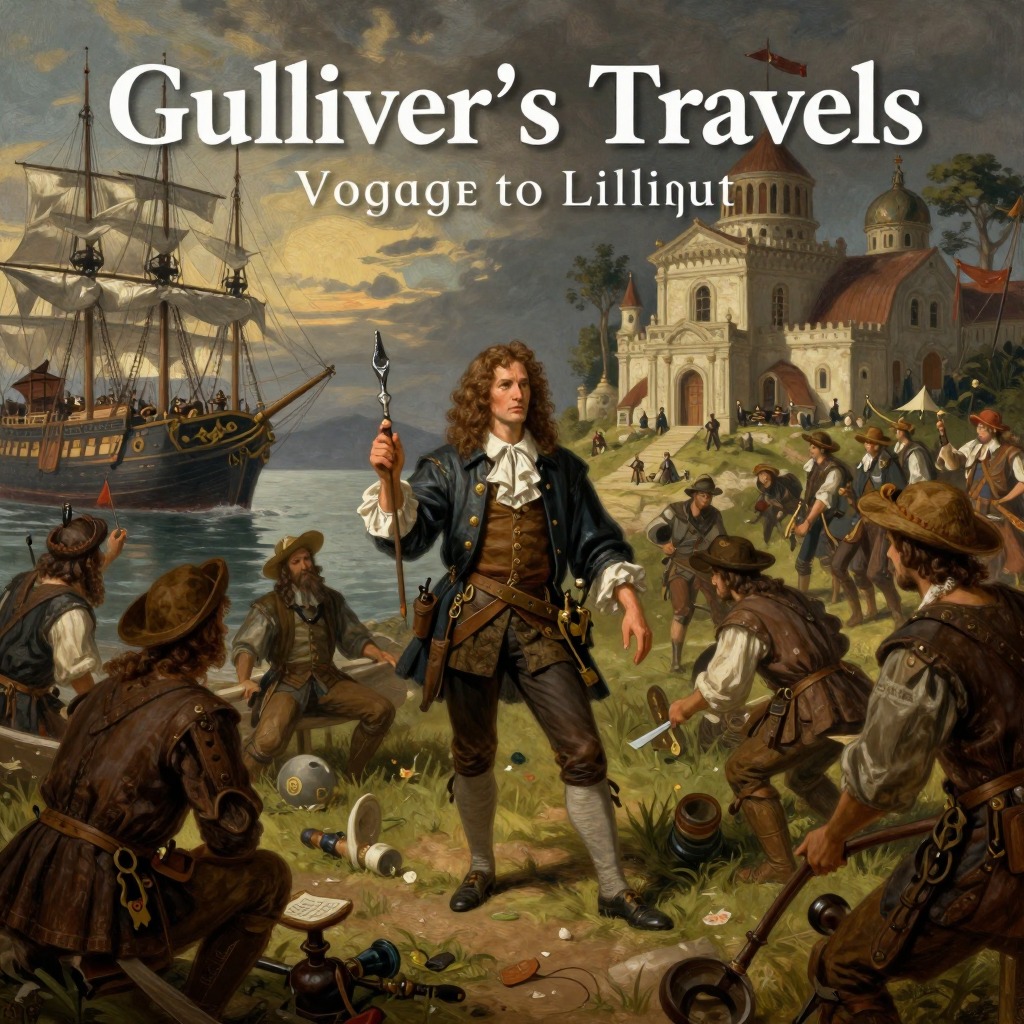
Gulliver himself contributes to the court's diversions in a very extraordinary manner. He requests the emperor to order several sticks of two feet high to be brought to him. Taking nine of these sticks, he fixes them firmly in the ground in a quadrangular figure, two feet and a half square. He then takes four other sticks and ties them parallel at each corner, about two feet from the ground, and fastens his handkerchief to the nine sticks, extending it as tight as the top of a drum. The four parallel sticks, rising about five inches higher than the handkerchief, serve as ledges on each side. When the work is finished, he asks the emperor to let a troop of his best horse, twenty-four in number, come and exercise upon this plain. He takes them up one by one in his hands, ready mounted and armed, with the proper officers to exercise them. As soon as they get into order, they divide into two parties, perform mock skirmishes, discharge blunt arrows, draw their swords, flee and pursue, attack and retire, discovering the best military discipline Gulliver ever beheld. The emperor is so delighted that he orders this entertainment to be repeated several days, and once is pleased to be lifted up and give the word of command. With great difficulty, he persuades even the empress herself to let Gulliver hold her in her close chair within two yards of the stage, from whence she is able to take a full view of the whole performance. Only one accident occurs: a fiery horse, belonging to one of the captains, pawing with his hoof, strikes a hole in the handkerchief, and his foot slipping, he overthrows his rider and himself. Gulliver immediately relieves them both, covering the hole with one hand and setting down the troop with the other. The horse that fell is strained in the left shoulder, but the rider gets no hurt, and Gulliver repairs his handkerchief as well as he can, though he will not trust to its strength again in such dangerous enterprises.
The Emperor's Grand Review
Two days after the recovery of his hat, the emperor, having ordered part of the army that quarters in and about the metropolis to be in readiness, takes a fancy to divert himself in a very singular manner. He desires Gulliver to stand like a colossus, with his legs as far asunder as he conveniently can. He then commands his general, an old, experienced leader and a great patron of Gulliver, to draw up the troops in close order and march under him: the foot by twenty-four abreast and the horse by sixteen, with drums beating, colors flying, and pikes advanced. This body consists of three thousand foot and a thousand horse. The spectacle of the entire army marching beneath the giant Gulliver is a vivid demonstration of his physical power and the emperor's willingness to use him as a living monument to his own authority.
The Political Context of the Diversions
The court diversions are not merely idle entertainments; they are deeply embedded in the political life of Lilliput. The rope-dancing and the leaping over sticks are the primary means by which the emperor selects his ministers and rewards his favorites. This system, as Gulliver later learns, was first introduced by the grandfather of the present emperor and grew to its present height by the gradual increase of party and faction. The diversions thus serve as a satirical commentary on the corruption and instability of court politics, where advancement depends on physical agility and the whim of the monarch rather than on merit or wisdom. The factions of the Tramecksan and Slamecksan, distinguished by the height of their heels, and the ongoing war with Blefuscu over the proper way to break eggs, further illustrate the absurdity of the political conflicts that the diversions are designed to manage. The emperor's own preference for low heels and his determination to use only low heels in the administration of the government, as well as the heir to the crown's tendency towards the high heels, show how even the most trivial distinctions can become the basis for deep political divisions. The diversions, therefore, are a microcosm of the larger political landscape of Lilliput, where power is obtained and maintained through a combination of physical prowess, arbitrary favor, and factional intrigue.